I'd promised myself that I would no longer take my split-lipped aunt’s car at night, I still drove it during the day when she asked me to drive her someplace. I also convinced her to let me take it to school some days. I usually took public transportation to high school. The only problem with taking my split-lipped aunt's car was that I did not have a school parking pass of my own and would borrow one from a friend when he knew he would be out sick the next day.
The last day I used her car to go to school ended poorly for me.
Feeling pretty strong about driving to school, the car growled into the parking lot a bit faster than it should have. Owned by an 60-year-old woman for twenty years and never gunned above 30MPH, it responded to my foot which in turn responded to the Rolling Stones. Pressing hard with my right, I made our entrance more dramatic by standing on my left foot. The brakes locked and spun the car towards a row of empty spaces. I almost pulled it off. She slid past my wish point--I wasn't aiming. No harm though. After she slowly rocked to a final groan, I eased this rectangular, red Dodge Dame back into the space, locked it, and strutted inside the school.
Satisfaction.
During my 3rd period Economics class, my teacher stopped the discussion and asked, "Hey, anyone know who drove that little red battleship into the school yard this morning?"
We were silent, not yet sure he meant me.
"Anyone see that car race into the yard this morning?" Mr. Payne continued.
Some hands raised simultaneously with his eyebrows; all noses pointed toward me.
"Was that you in that little red car?"
Yep.
"You little demon. That was some move."
The class laughed.
Classes switched and I walked to Chemistry with a deep sigh. I realized I hadn't switched out my books at Dominic's locker. Mine had been jamming for weeks and I never used it. Dom let me share his, but I had to work around his schedule--he had the only key.
A kid I barely knew, sitting near the windows, stood and waved to me, "Yo, Kel, your car is blocked in." I needed my Chem book--I had no idea where Dom was--Mr. Petrarch would kill me if I didn't have my book.
Everyone in class lined the windows.
Parked directly in front of my split-lipped aunt's car was a small white hatchback. Leaning against it was the principal of the school, Father Leonard. If I hadn't treated the parking lot like a theater of war, I would argue that he simply stopped to enjoy his cigarette.
He stared at it fondly as long slow exhales swirled and dissipated behind him.
Father Leonard was the cool recent addition to the high school. He once stood in the hall during a change of classes and brandished a large pair scissors over his head. As he SNIP SNIP SNIPPED the air he proclaimed, "JEWS MADE HERE! JEWS MADE HERE!"
Mr. Petrarch joined us at the window, placed a kind hand on my shoulder and said, "You'd better go see him."
It was the longest walk I ever took.
I popped open the aluminum exterior doors with an unintentional bang. The wind ripped both from my hands which made them echo like I came roaring out to attack Father. With his back to me, he didn't budge.
Instead, he took another captivating drag of his cigarette. The long helix of smoke
hurried busily into nothing.
With head bowed, I approached and stepped in front of him, "Father," I said, "this is my car."
He finished another long drag and flicked the cigarette away before looking at me.
His eyes were intense and hard. He stood straight and punched his finger into my chest. It knocked me back.
His finger kept at it as he started on me, "Don't ever drive in my school yard again. You walk. Don't ever ride in anyone's car in my school yard again. You walk. Don't ever approach me again unless I call you; you should be in class. You wait for me. Don't ever interrupt my enjoyment of one of my vices. You owe me a cigarette."
He stood taller than me, even though he wasn't and hitched at his pants like a gunslinger.
I blinked. There was silence until I simply asked, "What?"
"You heard me. You owe me a cigarette. Nothing filtered either."
I said, "I-I don't smoke."
"Oh shit, that's perfect, isn't it?" He flopped his arms to his sides exasperated.
We stood silent in the wind for a short time.
He turned toward the building and called over his shoulder, "I need a cigarette and I'm out. Don't you dare make a move."
And he disappeared back inside the building.
And I just stood there.
And stood there.
Silhouettes looked at me through the grated and green glass windows.
Classes changed and I stood in place. I thought about going in to see him, but he told me not to move and I was already in deep trouble.
I stood there the rest of the day. At the final bell, as the students hustled from the building to buses and cars, two secretaries approached me through the same doors I slammed open. One got into the white Honda as the other handed me detention slips for cutting class 4th period through the rest of the day.
Alone and still, I read and re-read five weeks worth of detention slips. One week for each cut class. The papers snapped in the wind as I pulled at the locked car door.
The car keys were in my jacket.
My jacket was in Dominic's locker.
Tuesday, May 31, 2011
Resource Book Review: What a Writer Needs
My rating: 4 of 5 stars
I am participating in a National Writing Project workshop from late June through mid July. Our first reading assignment has been Ralph Fletcher's What a Writer Needs. My initial reaction is that Fletcher does not necessarily distinguish teacher from student when he discusses writing. True, he provides many examples of work generated by students of all ages. This underscores the immutable reality that we are all writers and should view ourselves as such.
There are few writing exercises to be found here. That is not Fletcher's way.
What a Writer Needs promotes the concept that as a teacher of writers we need to be both guide who knows when to get out of the way, as well as an active and vital participant in the writing process. With guided encouragement, we are to help ourselves and our students write about the things and ideas which they truly care about.
Most students write far far better than they will ever know. We have to let children in on the secret of how powerfully they write. We need to let them take inspiration from they already do well.
Fletcher devotes several chapters to some of the better known tools of the craft: character, voice, beginnings and endings, tension, and language. I appreciate that Fletcher handles each of these less like a nuts and bolt chapter on what is right and wrong but more true to his overall message and tone of encouragement. We can learn how to tease these things out of our students, but only if they can see and hear their classmates successfully use them. Yes, you can use examples from literature, but the real sell on a soul is when one experiences the concepts and realizes that they truly are accessible.
As an aside, some of the most powerful messages delivered by Fletcher were the student samples included in his book--especially those from younger grades. It is natural for an English teacher to look at a piece of writing and think about how he/she would assess it...what comments we could have made.
Fletcher does not get into assessment or grading, and that is ok. This isn't that book. Additionally, there is an undertow in this text--stop setting kids up to please you. Stop asking for writing which earns your smile or disdain. Who we are and what we say and how we go about each affects students and their writing far beyond what we know.
I like that Fletcher uses and promotes the use of the word "mentor". Actually a prominent chapter of the book is on the role and good use of a mentor. I anticipate that a core element of the NWP experience will include mentoring. This word is changing the way I view my role in the class--there is indeed a different spirit to the word "mentor" as opposed to the word "teacher".
It is ok to be a mentor. It is ok to open your love of language, story-telling, and books to the students. While I see many similarities between the role of mentor and teacher, Fletcher categorization of our roles seem to blur as the same as what we expect of ourselves as teachers: high standards, build on strengths, value originality and diversity, encourage risk-taking, passion, and look at the big picture. The difference lies in the willingness to coach or guide--and I firmly believe that while all coaches are educators, not all educators have it in them to coach. Coaches can reach kids in ways that a teacher may not. That sounds harsh and perhaps critical, yet that is not the spirit or my intention.
With the right coach or teacher, the person becomes bigger than the text. A teacher or coach can be like a mountain--the closer your get to them, the bigger they seem. They care more about the name in the grade book (or on the jersey) than the letter/score in the grade book.
I think this can be a challenging transition of mind for some. I wrestle with it as I write this and as I read Fletcher's thoughts. I would never not consider myself a teacher, but I'm beginning to interpret what Fletcher means when he calls for us to mentor. My gosh, it is ok for me to write with my students...and share it? Isn't that a little self-absorbed? Isn't that risky?
Additionally, I struggled with the concept that it is more important to make time available for students to write, and I supposed that will be the greatest challenge for me.
How can I find or make time?
Where can I snip free some of the elements of my teaching which would allow for significant blocks of time for writing?
It is time for an overhaul of how I look at writing and have been trained to look at writing.
I applied to the NWP because after 16 years of teaching and experiencing many new initiatives, curriculum changes, philosophies, and adjustments because of law or nuance, I wanted a fresh perspective. I see this as an opportunity to step back and open my eyes and ears and overhaul what I do and why I do.
Fletcher's book What a Writer Needs could just as easily have been titled What a Teacher Needs, or What a Student Needs, because when it comes to the unique vocation of mentoring young writers, we write with and not for.
View all my reviews
Monday, May 30, 2011
A King Cut My Hair
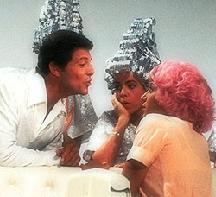
On the corner closest to our house a struggling barber shop owned by a king named Tony reopened for business. He looked like Frankie Avalon in Grease. I first saw his new white placard with gold glittering letters in the window as I walked home from school:
Open for Business.
As it was convenient, I had my poker straight Irish hair cut there. Once.
Tony tried to cut and coax my head into what all the men and boys in my neighbor had—a pompadour. I’m not certain if he noticed that I was a pre-pubescent Irish boy or if it didn’t matter either way. He knew what he knew and I sat in his kingdom.
I can still feel the backs of his fingers caressing the freshly soaked sides of my head. When he leaned back in a half crouch and admired the perfect lines formed by comb and hand, he swayed his hips and studied his proud work silently.
Tony slipped peppermints into my chubby fingers and set to work again.
And throughout his scissor and comb assault he hummed the same thing over and over: “Cheek-eh-di-dee, Cheek-eh-di-dee, Italian Festival” And then he’d bellow the second line each time like our business transaction concluded a rousing moment in an opera, “Cheek-eh-di-dee, Cheek-eh-di-dee eh-Mangia Festival!”
Tony was happy and bejeweled and sang loudly—he was like a king.
His pinky ring tapped cold against my jawline and ear as he coaxed stray hairs back into military order. In the corner, a black and white television with poor reception hissed and exhaled a Bob Hope film.
He smiled and hummed and clipped. Throughout the hour, my smock squeezed my throat uncomfortably.
“Cheek-eh-di-dee, Cheek-eh-di-dee…”
I only ever used water and a comb or brush to shove my hair to slide left or right. Never up and over and back. Now, Tony fit me with a hair crown on my head. He finished a can of hair spray on me and started another. By the end, I think water beaded up on it.
Italians from my neighborhood knew one way and that was it.
“Cheek-eh-di-dee, Cheek-eh-di-dee…"
Tony simultaneously stomped a foot and winked at me when he was done, proudly rapping the black comb twice on the counter. The Italian matador-king stood before me in triumph. His gold jewelry glittered and framed his very pleased smile as he guided a hand mirror around my new head.
"Itsa gotta be good, right?"
Open for Business.
As it was convenient, I had my poker straight Irish hair cut there. Once.
Tony tried to cut and coax my head into what all the men and boys in my neighbor had—a pompadour. I’m not certain if he noticed that I was a pre-pubescent Irish boy or if it didn’t matter either way. He knew what he knew and I sat in his kingdom.
I can still feel the backs of his fingers caressing the freshly soaked sides of my head. When he leaned back in a half crouch and admired the perfect lines formed by comb and hand, he swayed his hips and studied his proud work silently.
Tony slipped peppermints into my chubby fingers and set to work again.
And throughout his scissor and comb assault he hummed the same thing over and over: “Cheek-eh-di-dee, Cheek-eh-di-dee, Italian Festival” And then he’d bellow the second line each time like our business transaction concluded a rousing moment in an opera, “Cheek-eh-di-dee, Cheek-eh-di-dee eh-Mangia Festival!”
Tony was happy and bejeweled and sang loudly—he was like a king.
His pinky ring tapped cold against my jawline and ear as he coaxed stray hairs back into military order. In the corner, a black and white television with poor reception hissed and exhaled a Bob Hope film.
He smiled and hummed and clipped. Throughout the hour, my smock squeezed my throat uncomfortably.
“Cheek-eh-di-dee, Cheek-eh-di-dee…”
I only ever used water and a comb or brush to shove my hair to slide left or right. Never up and over and back. Now, Tony fit me with a hair crown on my head. He finished a can of hair spray on me and started another. By the end, I think water beaded up on it.
Italians from my neighborhood knew one way and that was it.
“Cheek-eh-di-dee, Cheek-eh-di-dee…"
Tony simultaneously stomped a foot and winked at me when he was done, proudly rapping the black comb twice on the counter. The Italian matador-king stood before me in triumph. His gold jewelry glittered and framed his very pleased smile as he guided a hand mirror around my new head.
"Itsa gotta be good, right?"
Subscribe to:
Posts (Atom)