Saturday, February 27, 2016

Loved to Write: The Sadness of the Past Tense

Something happens when we listen to our students--we learn. 

Donald Graves' Children Want to Write (edited by Thomas Newkirk and Penny Kittle) is a book that has become a tangible part of my growth as a teacher. Graves' fingerprints are all over my classroom and my practice.

Mostly, I read him. Now, that I am podcasting with my students, I hear him.

When we podcast, we talk about writing and reading. When asked, "Do you see yourself as writers?" the students seem to nudge the conversation from "kind of, sort of" to when they absolutely did see themselves as writers. They prefer to talk about when they used to see themselves as writers. The answer I hear more than any other is "third grade." Boys. Girls. They say, "third grade." Those who do not say "third grade," say "elementary school."

I'm still waiting for a student to say "middle school."

In trying to get to the bottom of what makes a student believe he or she is a writer, I am learning that encouragement is the foundation, and that correction, testing, homework, and stress (their words) are the wrecking balls.

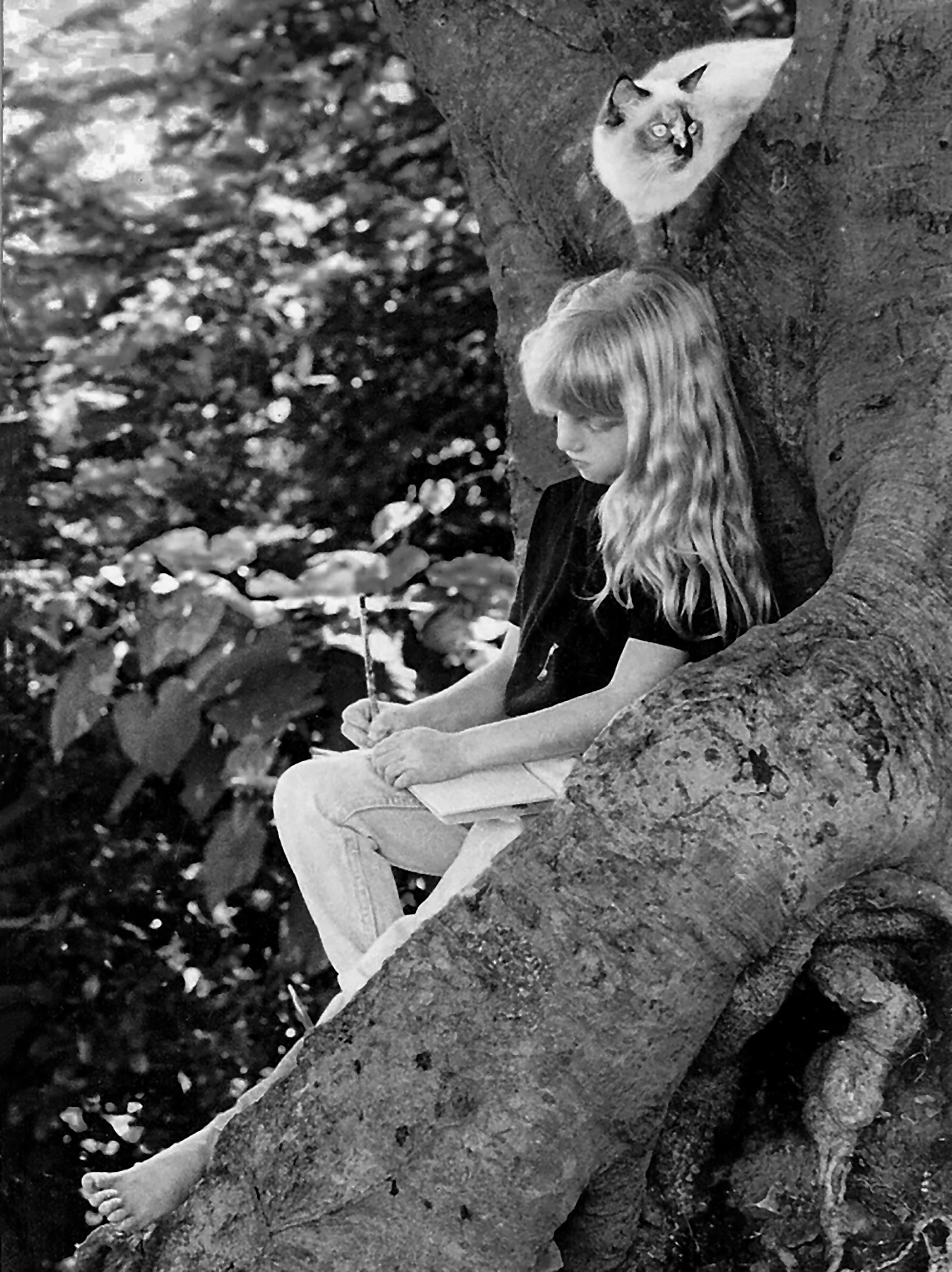
For example, Cass told me a teacher in elementary school rescued a piece of her writing from the recycling bin. Then, the teacher encouraged her to continue with it and to share it with others. That act made Cass believe she was a writer. I wish you could have seen her smile as shared that memory with me.

Em shared that her elementary teachers continually told her that she was advanced as a writer, that she was using techniques and tools naturally. By the way, Em was also a reader.
Credit: Irma Nazario Muniz
Their stories are all beautiful and they all share several common threads. They all saw themselves as writers because they were encouraged to. The students now struggle with seeing themselves as writers in middle school. They hesitate. They best they offer to my question is an unconvincing, limp, "sort of" or "sometimes."

When asked what is wrong, what happened, what is the difference, do you know what they report?

Stress. Homework. Tests. Grades. Correctness. An emphasis on errors. Their words, not mine.

Most actually acknowledge that school should be challenging. They agree that they need to be pushed, to be asked to perform more complex tasks. I find that most want to learn and want to grow.

But at what cost, when they all admit to stress.? They are 11, 12, and 13 years of age. Without strong, active, passionate mentors around them, writing literally disappears from their lives. There isn't enough writing in a curriculum. Furthermore, when the writing in a curriculum contributes to sucking the love out of writing--something is wrong. Dramatically wrong.

We don't own their writing lives, yet we act in ways that mitigates any future shot of these kids writing for themselves. Instead, they learn to write for the teacher or the test. They learn that writing is a task to be completed. For a score. And when the writing is done. It is literally done.

As I talk to more students, they specifically use the word love in the past tense...loved...when they talk about writing. And, they don't even realize they are saying it that way. But I hear it. I hear the past tense.

"I loved writing when I was a child,"

"Especially in third grade. All I wanted to be was a writer."

I fear that the loss of wanting to write, the loss of loving writing, is a loss in wanting to think, a loss in loving thinking...a loss of problem solving...a loss of creating. The very weaknesses pointed out to us from the pundits and critics come as a result of the pressure to change...the pressure to score...the pressure to be measured with tools that do not inspire growth. They inspire endpoints. And that is sad.

When we drive our kids to a finish line, we send a message that the exercise is done. Over. You finished in x place and you are an x writer. Yes, I see the humor in the sound...ex-writer.

Each time I hear my kids speak about writing in the past tense, it genuinely makes me sad. However, I know I can change the tense of the conversation.

I can encourage my students, yes. By writing and talking and listening.

And I can encourage teachers and parents. By writing and talking and listening.

Not everyone is going to embrace my words. Not everyone is going to be interested or understand. Admittedly, I did not fully understand until I started talking with and listening to my students. Before that could happen, however, I needed to create the conditions for understanding--I needed to become a teacher who writes. Are you a teacher who writes? If so, good! Are your colleagues? Help them. Encourage them...and not just the English teachers. All of this, of course, is designed to help more adults encourage students. It strikes me that some of the conditions of education actually discourage learning and growth.

How can we stand idly by and watch that continue to happen?

I encourage you to listen to my podcast The Classroom for ideas as to how you might start talking with your kids as well. If you do, share your discoveries and connections. We all need to encourage and learn from one another.

You can, and I can, encourage others by doing. By being a writer with our kids...and by being a writer for our kids. Using our writing to advocate for our students, and my writing today is one model of one type of contribution that we can all make. 

Sharing our conversations through blogs, publishing with professional journals, or taking the leap and publishing our own podcasts are contributions. Inviting others into the conversation is another model. We have all heard some variation of the observation that life is defined by what happens to us, but by what we do about it. So, what are we going to do about it?

I'm going to continue to write and talk and listen.

And I'm going to encourage my kids to remember the past and to change the tense of their words--and mean it. My goal is to hear my kids tell me by the end of the year that they love writing again, that they see themselves as writers because they are treated as writers...that they feel encouraged.

So, what can you do to modify the past tense in your kids? What can you do to help them rewrite the present and future tenses of our words?



Thursday, February 25, 2016

Learning to Listen

When I directed the middle school play for over a decade, I learned how to listen to young people. 

We began each rehearsal with "circle time." Everyone sat on the stage in a circle and took a turn to decompress from their day. At first, they talked about school. As the weeks went by, they talked about themselves. They talked about other people. They talked about society.

I said little. Mostly, I just listened.

It was ten solid years, often with more than one play, of training myself to listen to young people. To give them space without judgement.  And when kids are given space, they will be kids. They will vent and dream and complain and laugh and be everything that means being alive. Yes, there was an elephant in the room--I was an adult. There was no getting around that. However, I think--I hope--they came to respect the conditions I offered them.

I tried to be an adult in their life who valued what they had to say--without the impulse of giving an answer. Yet, their example ended up leading me to discoveries about teaching that I never anticipated. Yes, listening allowed them to lead me.

Fast forward to today and the classroom podcast, The Classroom.

The platform for the podcast is simple enough. I sit with two or three students during lunch and we talk. Mostly, I ask questions and they talk--and I listen. I purposely force myself to listen more than talk. 

Typically, in class, I have spent years asking students to talk about their specific essays or texts. Over the past few years, however, I have been inviting students to talk more about their decisions and experiences as writers and readers. And a whole new world was opened up to me.

I found myself growing as a teacher.

What my students have to say matches much of the documented evidence and research regarding reading and writing. I almost can't believe I ignored this living, breathing, emotional resource. It was right there in front of me all along.

So, I thought I'd bring it in front of you. And maybe you can turn to the kids in your classroom--the greatest resource you have. They have been there all along.

I hope teachers listen to the podcast for the sake of relearning how to listen. Listen to the questions I ask. Listen to me listen. Listen to my kids struggle, and listen to my kids share their sincerity. 

We all know teachers spend a lot of time talking. Talking is hard to avoid in our profession. But make some more space for listening. Listening--especially listening to student responses to questions that value what our kids think--allows space for critical thinking and engagement.

Asking better questions means asking questions that value their experience and questions that value the decisions they make. 

This podcast is a space to study what our young writers believe about reading and writing in addition to rethinking what we, the adults in their lives, believe about reading and writing.

Learning is about change and growth. And some of the best growth in my life has come from listening to and learning from the young people around me.

Sunday, February 21, 2016

Recognizing Sincerity

I'd heard in a documentary that Lucille Ball was mentored by Buster Keaton. Imagine those two comic titans hanging out in their youth, talking. Yet, as I scanned for mentor pairs online, I thought about the best mentors in my life, I realized mentors aren't really assigned in the real world. It doesn't work that way.
No one can assign a mentor.

We come to find mentors just by living. When we embrace something with all of our heart and energy, we come to find a respect for like-minded people--and we want to be around them. We want to learn from them.

I had some fun browsing a website dedicated to mentors, specifically a section highlighting mentor-mentee relationships : http://www.mentors.ca/mentorpairs.html. From here, I found a few relationships to dig into...

Credit: http://epmgaa.media.lionheartdms.com/
While nothing indicates that Elmore Leonard and Quentin Tarentino sat down over eggs and coffee and discussed writing, we do know that Tarentino read Leonard. At the very least, that is where their relationship began. Reading is one way of bringing ourselves by the side of someone whom we respect. All mentor relationships are not face-to-face. Relationships can develop an intimacy through reading. Want proof? Ask any poor soul who has ever written a poem to another.

For more tangible evidence, I found Zachary Colbert's The Books of Tarentino. In it, Tarentino said, “Elmore Leonard was a real mentor to me as far as writing is concerned. He helped me find my voice.”

In education, I like to think Nanci Atwell could not have become "Nanci Atwell" without mentors. The same must hold true for Penny Kittle, Kelly Gallagher, Ralph Fletcher...

I've read that Lucy Calkins was mentored by Donald Graves. And Graves had Don Murray. Murray had Graves. They were neighbors!

When we find our mentors, we contribute something to the relationship. It is not a host and parasite model. Sometimes what we bring is simply a hope or a seed of a goal to be something better than we are. Mentors must see something in a mentee. They must recognize something bigger than talent and effort. 

In Paul Bond's interview of Hollywood legend Jerry Lewis, we learn that while Spielberg considered Lewis a mentor, yet the great comic wasn't so sure, "[Speilberg was] in my class, but I doubt that [he] learned anything from me. [He was] well equipped at the time [he] came into the class."

Ultimately, I think what the mentor recognizes in others is sincerity. And the same is true, deep down, when we want to grow in a field. We gravitate to people who can help not because of what they know but because what is behind what they know--some call it passion. I am still going to stick with sincerity. Without it, whatever elements are already in place would never have been there to be noticed. We can all bring different talents and skills to the world--that isn't ever the real concern. 

The real concern is whether or not you are sincere.

I think a potential mentor can sniff out someone just in it for a paycheck.

I would be surprised if anyone sets out to be a mentor. Rather, I think people fall in love with their art, or science, or craft...and suddenly this other human being enters our life and we can't let them go. They bring something...pure...sincere...and full of hope. They may not bring answers. But they bring questions. Lots of them. And they remind us of ourselves because we too are full of questions.

And our questions only lead to more questions.

And questions lead to reading, conversation, writing, and experimentation. What the world recognizes as mentors and mentees, I want to recognize through another lens. We recognize the engagement, don't we? Not a mentor or a mentee. We recognize the sincerity--whether we agree with or understand it does not matter--it is the sincerity that helps us become colleagues.  Not the dumb luck that we work together in the same building or studio. With engagement and sincerity, we recognize something else as well--a friend.