The grace of connecting with students can sometimes last over lifetimes.
This week, Victoria Marini, literary agent at Gelfman Schneider in New York City, gave my 8th graders advice about their writing. Using Twitter, my students fired off questions about writing to the literary agent all day long. And, all day long, the literary agent responded. I was so proud of the questions the kids asked her. What they are writing matters to us and having the unique opportunity to engage with Torie was not lost on my students.
At one stage, an 8th grade girl looked up at me from her iPad and asked, "how did you connect with this literary agent?"
I taught Torie.
And the girl's face lit up. She didn't expect that answer. She said something along the lines of how cool that was as she made sure others around her knew what I had said.
Yep, years ago...I taught Torie.
Well, I "directed" her in the middle school play back in the late 90s. I remember casting her as the Dauphin in Henry V because I thought she had the natural instinct and sensitivity for it. More specifically, during auditions, I could already envision her playing the moment when the Dauphin receives the king's message that England would not give up. England would fight. The significance of that moment is that the Dauphin can see that this brash English King will win. That France is up against it even though they outman and out "gun" England. I knew she would play the significance of that moment. I knew she would "get" it.
It is 17 years since we worked on that play together, and I remember those decisions and I remember her sincerity as a person and as a young actor.
Torie came along on a school trip to the University of Wyoming that I organized. I set up a week long visit for fifteen kids interested in pursuing the arts in college. One of the professors, Leigh Selting, was so open to the idea that he let my students sit in on college theater classes and organized special training sessions in voice, fight, dance, set design, acting for the camera, et al. My kids even prepared monologues to deliver in front of their theater faculty. As Torie performed her scene from Paul Zindel's The Effect of Gamma Rays on Man-in-the-Moon Marigolds, Professor Selting turned to me and whispered, "She's so goooood. She's the real stuff."
I'll never forget that either.
When Torie went to high school she came back and assisted me with the middle school play. This act inspired many others to also help. For many years I often entertained anywhere from 6-10 student directors from the high school. Torie started that. And then she graduated. And, like so many of the kids we teach, she vanished into her life.
We lost touch until recently.
I reached out to Torie just as my current students were starting to write their collaborative MG novel. Fortunately, the timing worked out for us and Torie connected with my students on Twitter just as we started to read and comment on each others work.
As we shared our thoughts and questions about each others' work on post-its, we read them and crafted questions for Torie. Students were milling around the room, reading and writing, talking and Tweeting...it felt like a writer's studio. We were experimenting--together. We were talking about writing--together. We were thinking--together. We were creating--together.
And we also had someone help us. Someone who was just like them not too long ago. Someone who sat in these desks yesterday, and took the time today to model giving back and sharing.
When I knew the adolescent Torie on the stage, I made a point of drumming home the two words "Truth & Generosity" to my young actors. I did it so often I put a gold plate on our drama award that read "Truth & Generosity." We talked about it every day. We really did. That is not an exaggeration. We would talk about how we can find ways in our life to practice both of those virtues. For us, then, it was as simple as listening when someone else was talking, listening when someone else needed us.
Initially, I thought this blog post would be about the cool experience my kids had with writing, or Twitter, or a literary agent. Instead, I think what sticks most to me is the importance of how we make kids feel in our classrooms. And this week, a former student helped me make my current students feel like writers...they feel it...they believe they can do this. For some kids, it is the first time that they think of themselves as writers.
Thank you, Torie! Some connections do indeed last over lifetimes.
Thursday, November 20, 2014
Wednesday, November 19, 2014
Like it Matters
I don't want to ruin it for everyone.
That line is following me around at school. It waits for me in the morning. Flicking on the light to me classroom, the sound of it is long gone, but its impact left an echo that lingers.
I don't want to ruin it for everyone.
About two weeks ago I introduced a new project to my classes. We are writing a collaborative MG novel where each student is responsible for a 250 word segment.
We outlined a plot and broke it into 100 segments because, at the time, I had 100 students. Students chose their scene. One writer per scene.
Having secured funding, we will soon be sending our 50,000 word manuscript off to CreateSpace. We will be paying for three rounds of editorial services along with some of the other self-publishing services offered. Students will soon be receiving professional feedback. The editor's notes will soon ignite some great class discussion.
But before we cross that bridge, I wanted to share something.
When I asked my classes if they were excited to work together to publish a book, many raised their hands with enthusiasm. One boy exclaimed, "Think about it. How often in math do you actually get to go outside and measure a cylinder for some job site. I like that we actually get to apply things. We can write for real."
Some were not as excited initially. When I pressed on and asked what was going through the minds of those who did not raise their hands, one boy spoke.
He said, I don't want to ruin it for everyone.
I asked him to elaborate. And he did. But something else happened. Others spoke up too--both in agreement and support. The initial feelings were that no one wants to be person who writes the scene that ruins the book...so, we will talk about it. A lot. And read and help each other.
And talk about our writing, talk about our writing, talk about our writing. If nothing else were to come out of this at the very least I can say my kids talk and talk and talk about their writing like it matters.
Because it does.
As we selected scenes and then created drafts through the eyes and voices of six separate characters, I kept checking in with my students as they wrote. More often then note, they flagged me over to talk.
When we talked, we talked about characters, conflicts, dialogue, action, setting, and word choice. They asked me to read their work again and again. They passed around their notebooks and Chromebooks to each other on their own--wanting peers to read their work. Remember, it is only 250 words per student--a completely manageable number of words. It leaves a lot of room for conferring, revision, and experimentation with writing.
I don't have to press or lean on them. They bring the energy and a really interesting positive anxiety because in this moment their writing matters. It feels like a room full of athletes or performers about to step into the spotlight to do their thing--and the anxiety that courses through the veins of someone ready to simultaneously test and share themselves is very real among my kids.
After a few days I told my classes that I don't know if I could ever create this rush of importance, anxiety, pressure, and excitement with any other piece of writing. Usually, students try to write to me, their peers, our community. But now, the implication is that we are truly writing for real readers ...out there...readers who will have real opinions. We are paying to put an ISBN on our book. People will be able to buy our self-published effort internationally as well.
So, for the first time, ever, in twenty years in my classroom, all of my kids are feeling the same wonderful thing all at once:
it matters.
That line is following me around at school. It waits for me in the morning. Flicking on the light to me classroom, the sound of it is long gone, but its impact left an echo that lingers.
I don't want to ruin it for everyone.
About two weeks ago I introduced a new project to my classes. We are writing a collaborative MG novel where each student is responsible for a 250 word segment.
We outlined a plot and broke it into 100 segments because, at the time, I had 100 students. Students chose their scene. One writer per scene.
Having secured funding, we will soon be sending our 50,000 word manuscript off to CreateSpace. We will be paying for three rounds of editorial services along with some of the other self-publishing services offered. Students will soon be receiving professional feedback. The editor's notes will soon ignite some great class discussion.
But before we cross that bridge, I wanted to share something.
When I asked my classes if they were excited to work together to publish a book, many raised their hands with enthusiasm. One boy exclaimed, "Think about it. How often in math do you actually get to go outside and measure a cylinder for some job site. I like that we actually get to apply things. We can write for real."
He said, I don't want to ruin it for everyone.
I asked him to elaborate. And he did. But something else happened. Others spoke up too--both in agreement and support. The initial feelings were that no one wants to be person who writes the scene that ruins the book...so, we will talk about it. A lot. And read and help each other.
And talk about our writing, talk about our writing, talk about our writing. If nothing else were to come out of this at the very least I can say my kids talk and talk and talk about their writing like it matters.
Because it does.
As we selected scenes and then created drafts through the eyes and voices of six separate characters, I kept checking in with my students as they wrote. More often then note, they flagged me over to talk.
When we talked, we talked about characters, conflicts, dialogue, action, setting, and word choice. They asked me to read their work again and again. They passed around their notebooks and Chromebooks to each other on their own--wanting peers to read their work. Remember, it is only 250 words per student--a completely manageable number of words. It leaves a lot of room for conferring, revision, and experimentation with writing.
I don't have to press or lean on them. They bring the energy and a really interesting positive anxiety because in this moment their writing matters. It feels like a room full of athletes or performers about to step into the spotlight to do their thing--and the anxiety that courses through the veins of someone ready to simultaneously test and share themselves is very real among my kids.
After a few days I told my classes that I don't know if I could ever create this rush of importance, anxiety, pressure, and excitement with any other piece of writing. Usually, students try to write to me, their peers, our community. But now, the implication is that we are truly writing for real readers ...out there...readers who will have real opinions. We are paying to put an ISBN on our book. People will be able to buy our self-published effort internationally as well.
So, for the first time, ever, in twenty years in my classroom, all of my kids are feeling the same wonderful thing all at once:
it matters.
Thursday, October 30, 2014
Italian Bread Slathered in Red Gravy
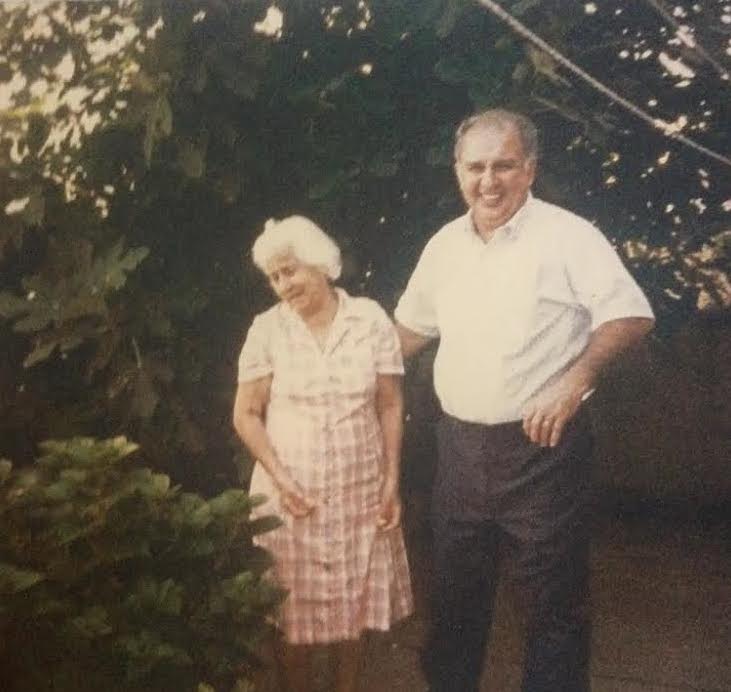
“When I was in my country, I was like this,” Beppa cupped one hand atop the other like a cage for a small bird. “When I come from the other side, I was like this,” and she opened her hands. I could see the imaginary bird leaping from her upturned palms. And then she reached into the low hanging branches above and picked one ripe fig for me, and one ripe fig for herself.
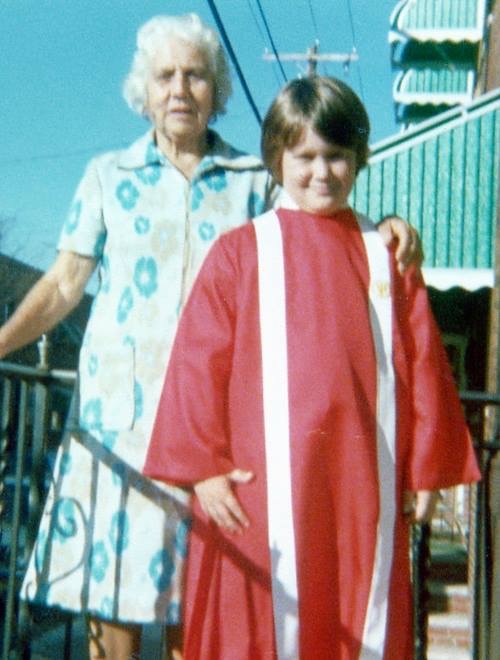
| Beppa and me before Confirmation |
“Beppa” is an Italian, female derivative of Josephine. Our Beppa’s name at birth was Guiseppa Ragolino. In America, she became Josephine Pratico. In our family legacy, the memories of our “Beppa” live on through Italian food and a fig tree.
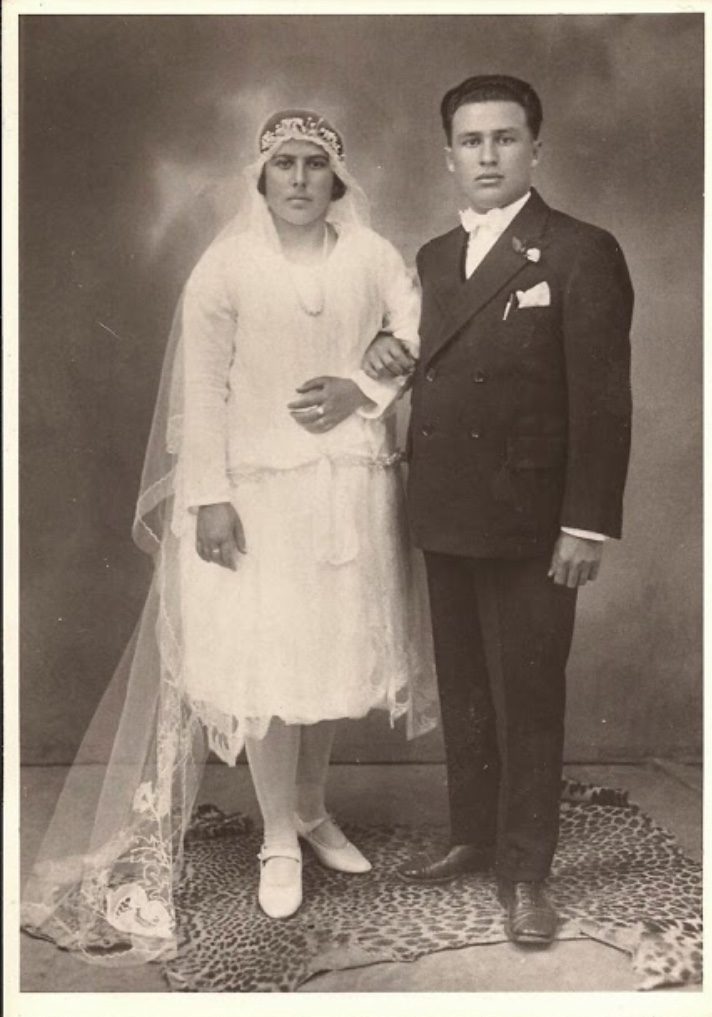
Beppa left Italy for America on a steamship in 1927. In her mid-twenties, Beppa said goodbye to her parents, a sister, the family farm, a region still limping from the 1908 earthquake, and a country licking its wounds from World War I. She could not know this at the time, but Beppa would see her father and sister only once throughout the rest of her long, loving life.
While Beppa’s memories travelled with her across the sea, our memories of Beppa continue to travel across time through our stories. We tell stories because we can no longer ask her questions. So, as a family, we share the stories so that we can know her better and begin to understand her joy and tenderness, her kindness and toughness, just a little bit deeper.
My aunt Joanne writes, “Could you believe this small, Italian woman who had nothing could leave such an impression on all of our lives?” We miss her like so many others in our family tree. Over the aroma of fresh, green basil and warm Italian bread slathered with red gravy, I wish everyone in our family could sit side by side again. I wish I could ask Beppa questions and pass my aunts, uncles, and grandparents her heavy plates of homemade raviolis, melting like butter by the forkful. I wish I could see the traces of soft, white flour on her apron again, and the bits of kneaded, fresh dough left behind on a wooden rolling pin. I would memorize her smile.
Because Beppa never learned to drive, and never owned a car, she walked to church and the vegetable stand. Trolleys clattered and trundled her off to work. My cousin, Marybeth, remembers Beppa walking home from the trolley--holding a black handbag close to herself--the white and blue uniform--the apron and cap that she wore every day until retiring at 65. In spite of living almost another 40 years after retirement--another lifetime for some-- Beppa’s lifetime never seems long enough.
| Beppa & Gregorio |
Born three years after her retirement, I knew Beppa as a grandmotherly figure surrounded by simmering red gravy, crusty Italian bread, and sweet, warm apple pies. She spoke broken English between steady streams of Italian--but when I stole fried meatballs from her kitchen--meatballs frying in oil--meatballs she turned over to brown and crisp with bare fingers--Beppa’s English fell swift and precise upon her little thief, “Hey! get the hell out of my kitchen!”
Used to doing goodness for others, Beppa growled and complained in Italian when the family threw a surprise party for her 80th birthday. But she overcame her Italian blood, and even allowed a tear of appreciation to well-up on her lashes. For once, she didn’t have to cook.
Each New Year’s Day, family and friends streamed through her kitchen. We followed the scent of homemade pizzas--the baked and charred crusts--the sweet, piney, and warm basil--the gooey, fresh mozzarella--and ladles of red tomato gravy spooned into the center of the shell and swirled in red concentric circles towards the edges of the crust. It was only day of the year I ever remember her making pizza. Cut into geometric shapes with a pair of red scissors, it disappeared faster than Beppa could bake them--the oven worked all day.
Some afternoons I found Beppa resting alone in a reclining chair by the front window. While the easy guess is that she watched people passing through the neighborhood, I imagine the farm girl noticed the bristling pigeons on the overhead wires or learned to trace time by the way long, black shadows crept across the red brick neighborhood.
Surviving a long fall down a fight of hardwood stairs in her mid-80s, Beppa walked away with a set of stitches in her soft, white hair and the early hints of dementia creeping into her life. For example, Beppa would eat and drink coffee all morning if family did not monitor her breakfast. Beppa would forget that she already had a cup of coffee and a piece of rye toast as she prepared breakfast a second time, and then a third time. When my aunt discovered that Beppa had eaten a half a loaf of rye bread one morning, Beppa shrugged and smiled--so cute and innocent.
For as long as I knew her, Beppa did not pay her own bills. My aunt, who lived next door, helped Beppa manage everything. Because Beppa's primary language remained Italian, my aunt read bills and letters written in English, and checked out books in Italian from the public library. Ever since Beppa first came to America, my family tried to teach her English.
Aunt Connie would say, “Beppa, say ‘one.’
And Beppa replied, “Say one.”
Another time, my aunt asked Beppa to show her how to make fried dough like the old Italians. My aunt laid all of the ingredients on the kitchen table: flour, eggs, oil, cold water, and powdered sugar. She scrubbed her hands with hot, soapy water, dried them on a clean towel, and said, “Ok, I’m ready.”
| Beppa and one of her sons, my Uncle Carmen |
Beppa said, “First, get a big pot and put it on a chair.”
Pulling a pot from a cabinet, my aunt paused, “Why put it on a chair?”
Beppa said, “Because I’m short.”
Although Beppa needed more help as the years passed, she cooked three meals a day well into her 90s. The black knobs on her stove no longer showed numbers or lines as the markings had been worn away with use. That oven produced decades of hearty peasant food to fill our plates: creamy pasta fagioli (beans and pasta); green beans and potatoes coated in red gravy; and bowls of buttery shellfish and garlic. Dinners came with a cold salad of tomato, red onion, vinegar, and oil. She dipped crusty bread into the salad, into her red gravy, into her morning coffee. Softening the food made chewing easier.
Today, in several yards behind several family homes across several states several fig trees grow. All of the trees are family. They sprang from cuttings from the original fig tree that grew in the back corner of Beppa’s yard. That initial fig tree did not grow on its own. Fig trees are not native to Philadephia. Beppa and Gregorio planted the cutting they kept alive for thirty days on a steamship--a tree suspended in metal cups of water to keep its roots soft --a tree they took turns holding open above deck to drink in the sun--a tree that survived the journey from Beppa’s family farm in Calabria, Italy--a tree that has carried her memories across the sea--a tree that carries her memories across time.
Subscribe to:
Posts (Atom)